Colour And Movement: How To Make Motion Stand Out In Aviation Photography
Oct 13, 2026
When people talk about movement in aviation photography, the conversation usually goes straight to shutter speed.
1/60th for a prop, 1/125th for a pan, and how low you can go before the aircraft turns soft and the shot is in the bin!
It’s important to think about this because when you slow the shutter down most of the detail in the background disappears, and what's left behind is colour.
A panning shot at 1/80th turns a hedge line into a green streak. A prop at 1/60th becomes a disc that takes on the colour of the sky behind it, or a circle of silver, edged with yellow. A smoke trail is only as strong as the difference between its colour and that of the sky. It’s clear that colour is a big part of what tells the viewer where to look and which way things are going.
Colour Balance is one of the ten criteria the judges use in High Roller, our aviation photography competition, and the theme is Movement. So this week's Tutorial Tuesday goes through the seven High Roller categories one at a time and looks at what colour is doing in each of them.
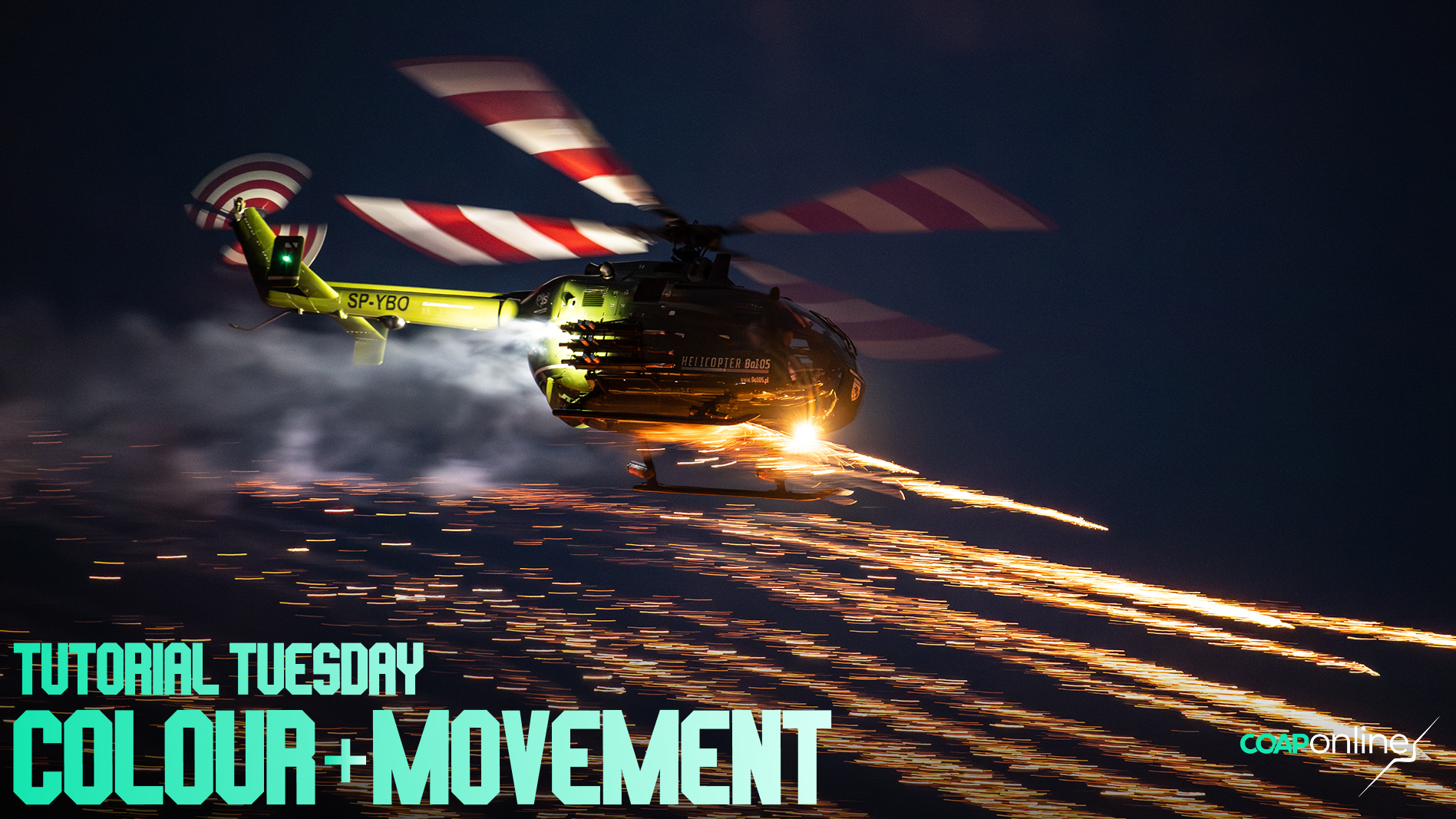
Panning
In a good pan the aircraft is sharp and everything behind it is streaked, so the background gets turned into bands of colour. That's where a lot of panning shots go wrong in the edit. A bright green field or a yellow crop can end up distracting from the aircraft, and a boost of Vibrance or Dehaze across the whole image makes it worse. Before you add anything, look at the streaks and decide whether their colour is helping or confusing. Pulling the saturation of the background down a little, usually the greens and yellows, lets the aircraft come forward without you having to touch it.
Prop & Rotor
A prop disc is see-through, so it picks up a colour bias of whatever's behind it. Against grey cloud it can look muddy, and against blue sky it looks clean. The detail worth looking for is the tips. Plenty of propellers have painted tips, often yellow, and at a slow shutter speed they draw an arc of colour that shows the rotation better than the blur does. Don’t go over the top, but let it be the brightest colour in the disc. Helicopters work the same way, and the dust or spray thrown up under the rotors carries the colour of the ground, which is worth keeping.
The Elements
Vapour, spray and rain are mostly water, and water takes on the colour of the light. Late in the day, vapour over a wing goes warm, and in shade it can get into the blue balance. Neither is wrong. You just need to decide whether the vapour is carrying the colour of the light or sitting there as clean white, and then deliberately edit it that way. Rain and spray show up best against something dark, so it's often the brightness of the background you need to work on rather than the water itself.
People
The colour that often comes off too strong in people shots at an aviation event is hi-vis yellow. A ground crew vest will drag the eye away from a pilot's face or a marshaller's signal, so look at it first and calm it down if it isn't where the story is. Skin is the other obvious thing to check. Light with multiple White Balance values on a flight line can turn skin green or orange, and odd skin tones are something viewers pick up on very quickly.
Composition
Our eyes tend to go to warm, bright, saturated colour before anything else. You can use that to natural steer the viewer through the image in the direction of travel. A red tail, warm light on the nose or a cool shadow behind the aircraft can all pull the eye the way the aircraft is going. Warm against cool is the simplest version of it: the aircraft separates from the background without needing any extra contrast. The opposite also holds true, so watch out for the brightest warm colour sitting behind the aircraft and pulling the eye backwards.
Trails
Smoke and contrails stand out because of the contrast between them and the sky. White smoke in shadow edges towards blue tones, coloured display smoke clips in the red channel quickly if you push it, and a contrail at altitude looks its best against the deep blue at the top of a clear sky. When you edit a trail, fix any colour cast on the trail itself with a local adjustment rather than changing the whole image. That way the sky keeps its colour.
Interpretation
This is the category where colour can do the most. Movement doesn't have to mean speed, and the brief suggests ideas like change over time or a preservation movement. Colour grading is one of the strongest ways to show that. A muted, warm grade on a restored warbird says something different to a clean, cool grade on the same aircraft. Toning and black and white conversion are both allowed in the rules.
What the rules allow
White balance, colour, curves and toning are all normal editing and all fine. What you can't do is add anything: no extra vapour, smoke or cloud, and no sky replacements! If your shot is shortlisted, the judges compare it with your original file, so keep the colour believable and make sure it still looks like the same photograph.
Enter High Roller
Entries are open now and close on Saturday 31 October at 23:59 GMT. You can enter any aircraft photograph you've taken since 12 October 2023, on any camera,, so there's a good chance your entries are already sitting on your hard drive. The overall winner gets £2,000 of new camera gear from Clifton Cameras, or $2,000 in cash outside the UK, plus a double-page spread in the January 2027 issue of Combat Aircraft Journal. All seven category winners are printed in that issue.
It's open to photographers aged 18 or over in the UK, the EU, Norway, Switzerland, the US, Canada, Japan, Australia, New Zealand and South Africa. If you registered for The Free 3-Day Workshop, you've already got one free entry: look for the email from Kōlab to redeem it.
The brief, the seven categories and the five judges are all on the competition page here: www.coaponline.com/competition
Inside COAP Online, the full version of this tutorial is in The Merge, with the exact Lightroom moves for every category. The High Roller Pack gets you The Merge and three entries every month for £19 a month, and you can see everything it includes on the competition page.
Did you know our blogs are written exclusively by photographers inside the Accelerator? We'd love for you to come and see what COAP Online is all about.
Not yet part of the Aviation Photography Accelerator?
Start this month for £19
Every month the whole community locks onto one Focus Subject and learns it live with our pro instructors. You also get instant access to everything we have ever made: 30+ workshop replays, 150+ tutorials, four pro masterclasses, and The Merge, our private community of 500+ aviation photographers.
Cancel any time. 30-day money-back guarantee.

Included with the Accelerator
Exclusive gear discounts at Clifton Cameras
Everyone inside the Accelerator qualifies for exclusive pricing on cameras, lenses and accessories through our retail partner, Clifton Cameras. The saving on a single purchase can cover several months of the Accelerator.
Discounts available across









Get a free tutorial to your inbox every week!
Subscribe to our mailing list to receive a fantastic aviation photography tutorial to your inbox every Tuesday!
We hate spam as much as you. We will never sell your information, for any reason.